
Cambodia Loses LDC Status in 2029: Should Bag Buyers Panic?

Spoiler: Probably not. Here's what the headlines aren't telling you.
TL;DR
Cambodia graduates from LDC status in 2029 — but impact varies dramatically by market
US-bound products: No change — you're already paying full duties
EU-bound products: 0-6% potential increase — unless Cambodia gets GSP+
Your FOB price won't change — duties are your cost, not your supplier's
You have 3 years to prepare — no need to panic
Bottom line: Run the numbers before making any moves
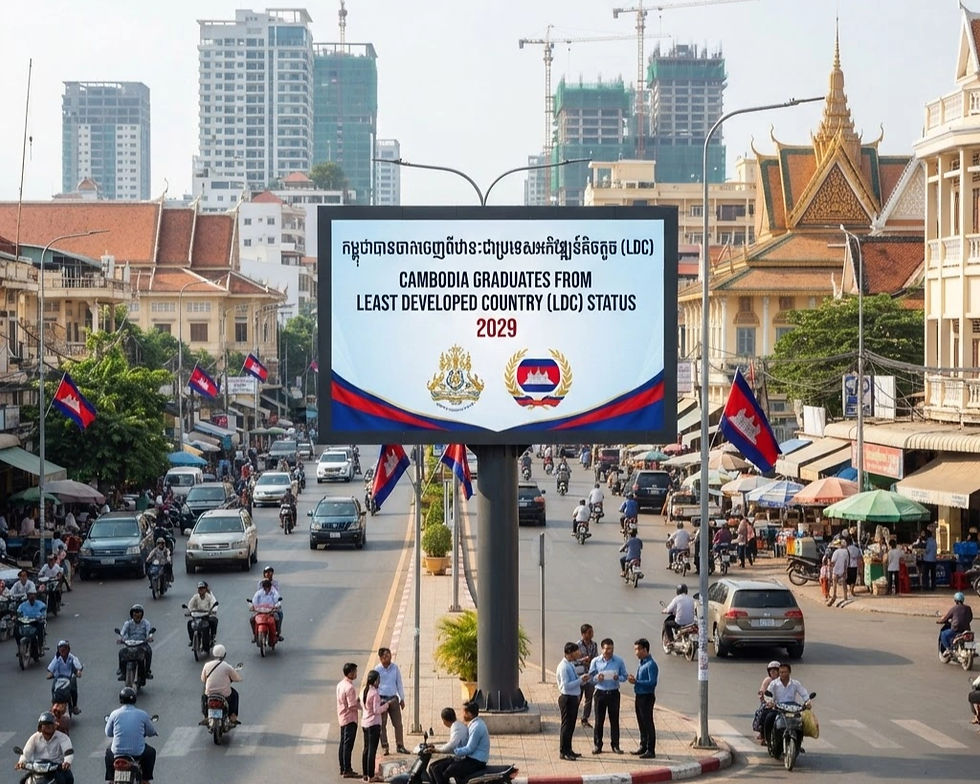
The Headline vs. The Reality
You've probably seen the news: Cambodia will graduate from Least Developed Country (LDC) status by 2029. Prime Minister Hun Manet confirmed the timeline. The garment industry is buzzing.
If you source bags from Cambodia, your first question is probably: "How much more will I pay?"
Here's the honest answer from a manufacturer's perspective: It depends entirely on where you're shipping.
And for many of you, the answer is: Nothing changes.
Let's Cut to the Chase: Impact by Market
Your Market | Current Duty (2026) | Post-2029 Duty | Change | Action Required |
United States | 17-20% MFN | 17-20% MFN | None | None |
European Union | 0% (EBA) | 0-6% (GSP/GSP+) | 0-6% | Plan ahead |
United Kingdom | 0% (DCTS) | Likely 0% | Minimal | Monitor |
Japan | Reduced (GSP) | Transition | Varies | Monitor |
Australia | 0% (LDC) | 0-5% | 0-5% | Plan ahead |
The big reveal: If your primary market is the US, Cambodia's LDC graduation is essentially a non-event for your costs.
Wait, Why No US Impact?
Here's what most articles don't mention:
The US GSP program expired in December 2020 and hasn't been renewed. Cambodia's GSP eligibility was also partially suspended that year.
This means you're likely already paying full MFN duty rates on bags from Cambodia. There's no preference left to lose.
Bag Type | MFN Duty Rate |
Textile backpacks | 17.6% |
Textile handbags | 17.6-20% |
Leather handbags | 5.3-8% |
Travel bags | 6-20% |
These are base MFN rates. Additional tariffs (2025-2026) may apply to all origins, but these are unrelated to LDC status.
Cambodia's LDC graduation doesn't affect your US duty situation. Any additional tariffs you're paying today will remain the same after 2029.
No change. Zero. Nada.
The EU Is Where It Matters
For EU-bound products, there's a real conversation to have.
Currently, Cambodia enjoys Everything But Arms (EBA) access: 0% duty, no quotas. After graduation, this shifts to standard GSP treatment.
Two scenarios:
Scenario | EU Duty Rate | Likelihood |
Cambodia achieves GSP+ | 0% | Moderate-High |
Standard GSP only | 3-6% | Moderate |
The good news: Cambodia is actively pursuing GSP+ status, which requires commitments on labour rights, environmental standards, and governance. Given Cambodia's existing compliance infrastructure (Better Work, BSCI, SEDEX audits), this is achievable.
The math on a $15 FOB backpack:
Scenario | FOB | Freight | CIF | Duty | Landed Cost |
Current (2026) | $15.00 | $2.00 | $17.00 | $0 | $17.00 |
Post-2029 (GSP+) | $15.00 | $2.00 | $17.00 | $0 | $17.00 |
Post-2029 (GSP) | $15.00 | $2.00 | $17.00 | $1.02 | $18.02 |
Worst case: $1.02 more per bag. Or about 6%.
A Critical Point: FOB vs. Landed Cost
Here's something that gets lost in these discussions:
Import duties are YOUR cost, not your supplier's.
Most Cambodia manufacturing operates on FOB (Free on Board) terms. The duty is charged when goods enter YOUR country, not when they leave Cambodia.
Who Pays What | Cost Component |
You (the buyer) | Import duties, customs clearance, landed cost calculations |
Your supplier | Manufacturing costs, materials, labour → FOB price |
Your supplier's FOB price is based on their production costs—not your import duties. If duties go up, that's a line item on your import paperwork, not your supplier's invoice.
How Cambodia Stacks Up Against Alternatives
Before you start shopping for a new sourcing country, let's look at the real numbers.
For US-Bound Products
Origin | FOB Index | Tariff Burden | Landed Cost Index | Risk Level |
Cambodia | 100 | Lower | Competitive | Low |
Vietnam | 115-125 | Similar | Higher | Low |
Bangladesh | 85-95 | Higher | Variable | Medium |
China | 130-150 | Significantly higher | Much higher | Medium |
Cambodia = 100 baseline. US tariff rates are subject to change; contact us for current rates on specific HS codes.
Key takeaway: Cambodia maintains a competitive landed cost position. Lower FOB than Vietnam and China, lower tariff burden than Bangladesh and China, and lower compliance risk than Bangladesh.
For EU-Bound Products (Where Duty May Change)
Origin | FOB Index | Post-2029 EU Duty | Landed Cost Index | Risk Level |
Cambodia (GSP+) | 100 | 0% | 100 | Low |
Cambodia (GSP) | 100 | 3-6% | 103-106 | Low |
Vietnam | 115-125 | 0% (FTA) | 115-125 | Low |
Bangladesh | 85-95 | 0% (EBA) | 85-95 | Medium |
China | 130-150 | 12% | 145-168 | Low |
Even worst-case, Cambodia is competitive with Vietnam and far cheaper than China.
The only country with a clear cost advantage is Bangladesh—but that comes with trade-offs.
The Bangladesh Question
Yes, Bangladesh has lower FOB costs. Yes, they'll keep EBA access longer. But here's what the spreadsheet doesn't show:
Factor | Cambodia | Bangladesh |
Minimum wage | ~$200/month | ~$95/month |
Compliance track record | Strong | Improving but checkered |
Lead times | 45-60 days | 60-90 days |
Order flexibility | Good for smaller MOQs | Optimized for large volume |
Communication | Strong English in management | Variable |
Political stability | Stable | More volatile |
The hidden costs of "cheaper":
Hidden Cost | Typical Impact |
Failed audits | $5,000-20,000 + delays |
Quality rejects | 2-10% of order value |
Late delivery (air freight) | $3-8 per kg premium |
Reputation risk | Unquantifiable |
Management time | Hours of firefighting |
When you add up total landed cost including risk, the 3-6% EU duty increase often disappears.
🔍 The Bigger Picture Here's a point buyers often miss: Cambodia isn't alone in graduating. Bangladesh, the largest garment exporter among LDCs, was originally scheduled to graduate in November 2026. However, citing economic challenges, Bangladesh has now received UN support for a 3-year extension to November 2029 — the same year as Cambodia. After 2029, the only remaining Asian LDCs will be Afghanistan, Myanmar, Timor-Leste, and Yemen — none of which are viable for bag manufacturing. The "LDC preference shopping" strategy is essentially dead.
What You Should Actually Do
You have 3 years. Here's your timeline:
2026 (Now)
Action | Priority |
Identify which products go to which markets | High |
Document current duty rates by HS code | High |
Calculate your actual exposure | High |
2027
Action | Priority |
Build duty scenarios into 2028-2030 budgets | High |
Talk to your Cambodia suppliers about their plans | Medium |
Monitor GSP+ negotiation progress | Low |
2028
Action | Priority |
Lock in partnerships with preferred suppliers | High |
Finalize pricing strategy | High |
Prepare stakeholders for any cost changes | Medium |
2029+
Action | Priority |
Execute your plan | — |
Adjust based on actual GSP+ outcome | Medium |
What NOT to Do
Mistake | Why It's a Mistake |
Panic and switch suppliers now | You have 3 years; rushed decisions = bad decisions |
Assume FOB prices will rise | Duties are your cost, not theirs |
Ignore it completely | EU buyers need to plan |
Chase the lowest possible cost | Hidden costs often exceed duty savings |
The Bottom Line
Cambodia's LDC graduation is an economic success story, not a sourcing crisis.
For US buyers: Your situation doesn't change. At all.
For EU buyers: You're looking at 0-6% potential duty increase—possibly zero if Cambodia achieves GSP+. That's manageable with planning.
For everyone: The competitive equation is about more than duties. Quality, compliance, reliability, lead times, and communication all matter. Cambodia still delivers on those fronts.
Three questions to ask yourself:
What's my actual duty exposure by market? (Calculate it.)
What's the total cost of switching, including hidden costs? (Be honest.)
Am I making this decision based on data or headlines? (Check yourself.)
Our Perspective as a Manufacturer
We're not going to pretend this is all upside. Some brands will use LDC graduation as a reason to renegotiate or move orders. That's business.
But here's what we're doing:
Investing in capabilities to compete on value, not just price
Maintaining compliance standards that reduce your risk
Being transparent about what's changing and what isn't
The brands that stay will get stronger partnerships. The brands that leave based on a 3-6% duty increase may find the grass isn't greener.
Either way, let's make the decision based on real numbers—not headlines.
Need to Run the Numbers?
We're happy to help you calculate your actual duty exposure for specific products. No pitch, just math.
Contact us with your HS codes and destination markets, and we'll help you understand what LDC graduation actually means for your business.


Comments